

With photography being so prevalent these days, many realistic/naturalistic painters depend upon working from photographs rather than directly from a subject. One of the down sides of depending totally on photographs is our tendency to see their images two-dimensionally rather than to perceive the subjects three-dimensionally, and that can cause our work to feel flat.
That is important because, aside from how value works as a design element, it's the number of light source's rays that touch three-dimensional images that mostly determine their values.
LET'S DELVE FURTHER INTO THAT
Everything around us is made up of planes either flat or rounded. Those planes collect light rays in various amounts. The degrees to which light rays hit or miss a plane determine that plane's value.
THE ASARO HEAD
During the 1970's, artist John Asaro designed a 3-D model of a human head according to its anatomy in planes. Most folks limit their study of it to portrait drawing, but studying it to recognize how planes work is an excellent exercise for all visual artists.
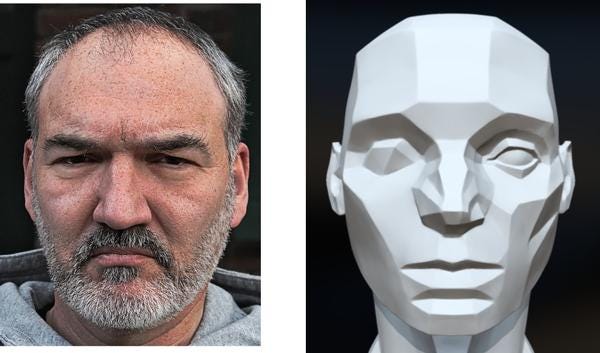
On Pixabay, I was able to find this man's photo with a similar lighting as the Asaro head. You see that the angle from which the light is coming is above in both images.
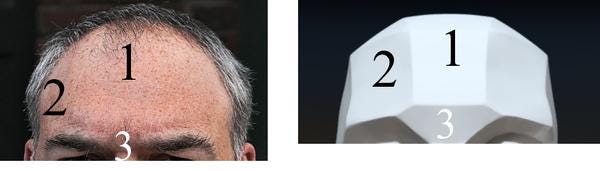
Notice how planes numbered 1 are the lightest in value because they receive the highest number of light rays. Those numbered 2 are slightly darker in value because they receive slightly fewer rays. Darker planes (numbered 3) are turning even further at a deeper angle away from the source, therefore receiving even fewer rays.
The planes directly under the eyebrow line are in shadow values because they receive no direct light rays.
TRY THIS:
The button below takes you to Sketchfab, a page that allows you to manipulate an Asaro head. By holding down the left click of your mouse and moving it in all directions, you can study the various values the planes. This model has only one light source, but playing with it can still help you develop an awareness of seeing two-dimensional images accord to their three-dimensional structure.
Go To Sketchlab for the Asaro Head
Creating this awareness of the planes within images can help you see, not just portraits, but all kinds of photographed subjects in planes. This insight will better inform your painting skills, preventing the risk of your work from feeling flat.
Here is a video in which Cesar Santos illustrates this principle.
