

These days, there is a lot of confusion about color wheels. Why are there so many? Which one is the “correct” one? Why bother with a color wheel anyway?
Before I go further, we should clarify some terms: Primary Colors are hues from which all other hues can be mixed; Secondary, a hue visually mixed from two primaries; Tertiary, a hue visually mixed from a primary and a secondary.
Now, here we go:
THREE MAJOR WHEELS (SYSTEMS)
Although many color systems have emerged over the decades since Isaac Newton designed the first color wheel, three major color systems are most popular among artists across genres today.
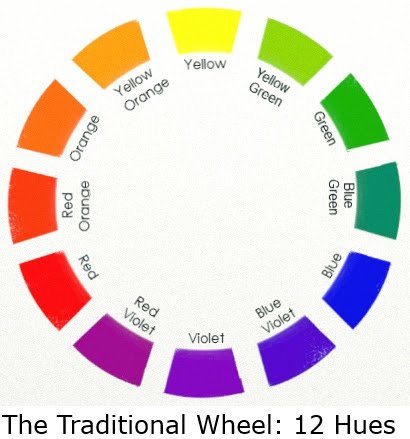
THE TRADITIONAL WHEEL
Also referred to as the Newton Wheel, although it is a variation of Isaac Newton’s original wheel of the 18th century, the traditional wheel is based on three PRIMARY hues perceived as yellow, red, and blue; three secondaries that are visual mixtures of two of the primaries, and six tertiaries, visual mixtures of a primary and a secondary.
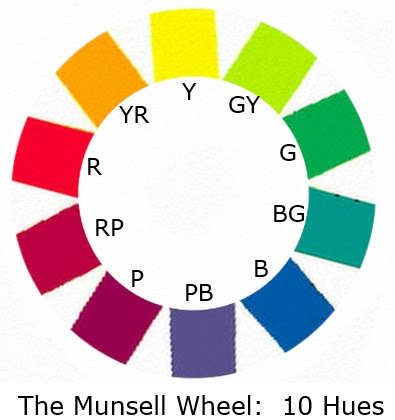
THE MUNSELL WHEEL
Developed by Albert Munsell in the early 20th century, this system uses a color wheel based on five hues he identified as primaries and five as secondaries. He classified as secondary a visual mixture of the hues he perceived as two primaries. Noticed that Munsell deviated from the traditional definition of primary and secondary, and totally leaves out the tertiary.
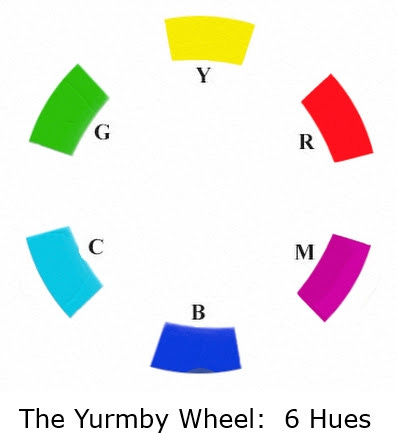
CYMK (aka YURMBY) WHEEL
The term “Yurmby” is (I think) coined by James Gurney. It consists of six hues, all perceived to be primaries: yellow, red, magenta, blue, cyan and green-- thus the acronym “yurmby”. It’s the same model known as CYMK, a system created for color printers. (Google CYMK for more).
WHICH ONE TO CHOOSE
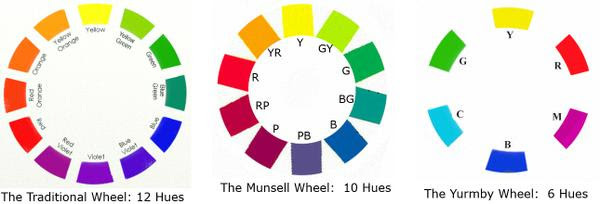
When we examine these three systems, it is notable that each appears to be an effort to derive the fewest hues from which all other hues can be mixed. However, each is based on a different perception of hue. For example, Munsell sees purple more red than Newton and the CYMK renames some of the hues.
Which one is best to use? Well, that depends upon which artist you ask. James Gurney would say the Yurmby (CYMK) whereas Richard Schmid (now deceased) and I would choose the Traditional. Had Richard lived, he and I would be about the same age, so each of us cut our teeth on the Traditional wheel, and neither of us is too shabby at mixing color. James was born almost 2 decades later, so he leans towards the more modern wheel, and he, too, is an excellent color mixer.
Truth is, it doesn’t matter. They all yield the same results when mixing pigments. Each artist adapts the wheel that works best for her or him. With that in mind, avoid getting all caught up in the dogma of any of us. You can walk into a gallery where paintings are produced according to each system and be unable to determine which system was used for any one of them.
Just find yourself a wheel that feels right and learn to think with it.
Thanks for sharing. I really think that by painting value chart of each color from the color wheel, for me, has helped me when mixing colors whether is is acrylics, Gouache, oils or watercolors. It is like the old saw: How do you get to Carnegie Hall? Practice, practice, practice. Thanks Dianne for all the content you have provided me and your followers.