

Italian Renaissance architect Filippo Brunelleschi is credited with discovering that when we look at parallel lines moving away from us, our eyes perceive them as converging to a single vanishing point. What's amazing is that this scientific fact is also an artistic principle called one-point perspective.
I doubt if Brunelleschi imagined what clever maneuvers future artists would use in their paintings. I thought it would be fun to share a few of those with you.
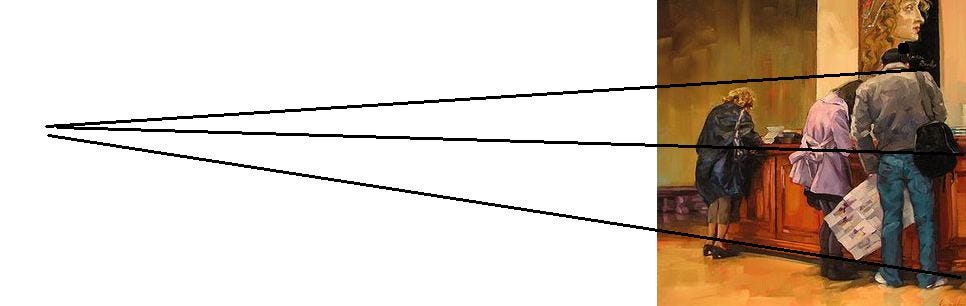
Karen Jurick uses it in this painting to show the depth of a room and to show the distance between the couple on the right and the individual on the left. And the lines' converging outside the paintings gives us the sense that there is a continuation of something beyond the painting itself.
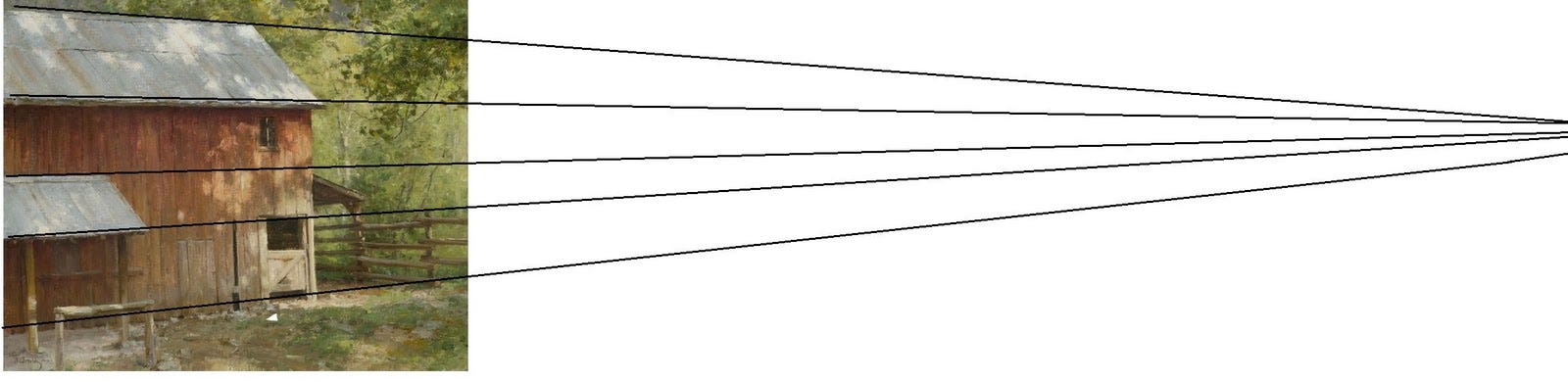
Clyde Aspevig shows a similar continuation beyond the painting with the same method.
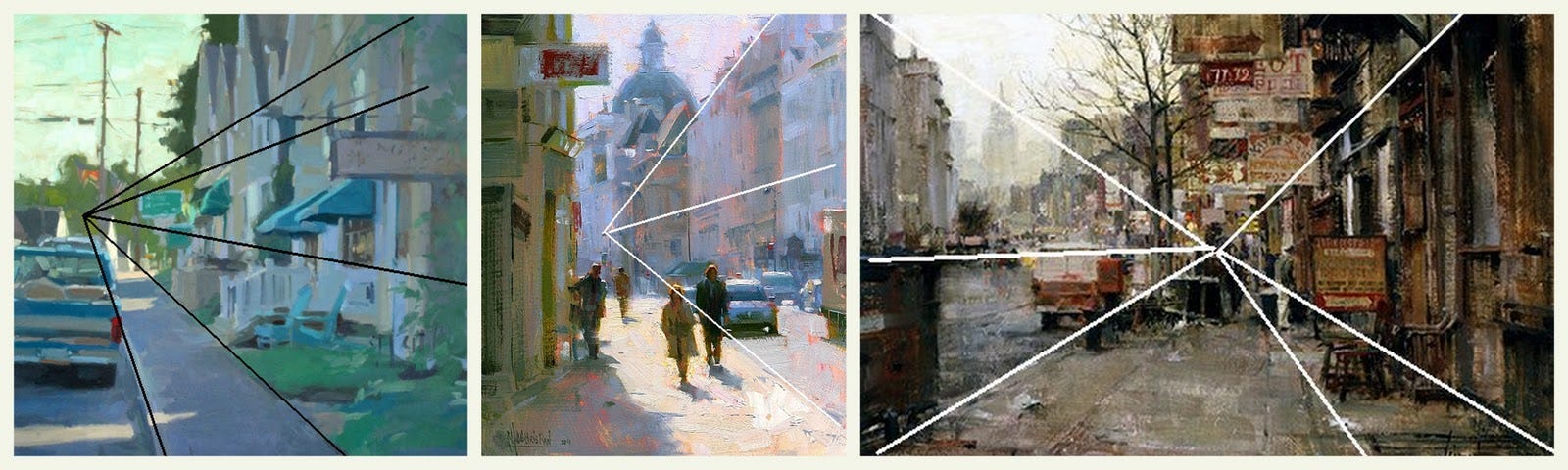
Colin Page, Jennifer McChristian, and Richard Schmid (respectively below) each used the convergence to keep the viewer inside the painting, each showing a different variation on where the lines come together, therefore each placing the viewer in a slightly different vantage point.
Whether the vanishing point is placed inside or outside the painting, we have the illusion of being in a three-dimensional space.
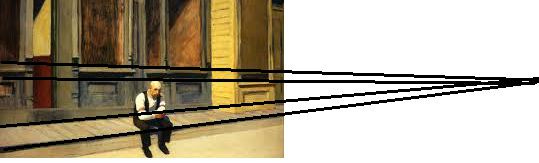
Like Aspevig and Jurick, Edward Hopper's lines converge outside the painting. He chose to place the viewer slightly to the left of the sitting man rather than peer directly at him, giving the feeling that the man is sitting on a walkway that extends beyond the painting.
Using converging lines gives both order and dynamics to a painting: order in that shapes are aligned rather than being randomly placed, and dynamics in that converging lines keep the eye moving. Keeping this in mind, the artist need not memorize the rules of perspective.
That’s a lovely thought!