

Many emerging painters complain about their values not being “clean” and most are at a loss as to what to do about it. If you’ve never heard this particular term before, having “clean values” is simply artspeak for a painting with convincing colors and strong, visually meaningful values, such as in this little forest scene painting by James Gurney.
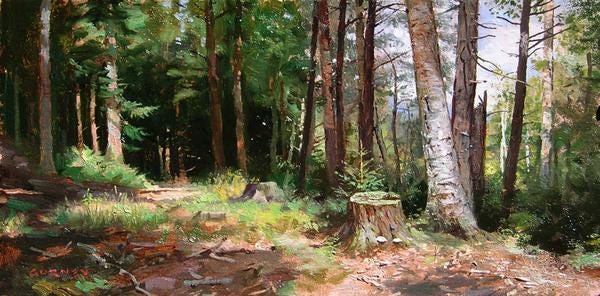
Gurney’s darks, midtones, and lights each play a role in defining something specific about the forest. His shadows and lights describe the position of the light source as well as its effect upon the subject, so there’s no doubt about what’s going on. Let’s take a closer look at some of the mechanics at work here.
1. Meaningful Areas of Emphasis
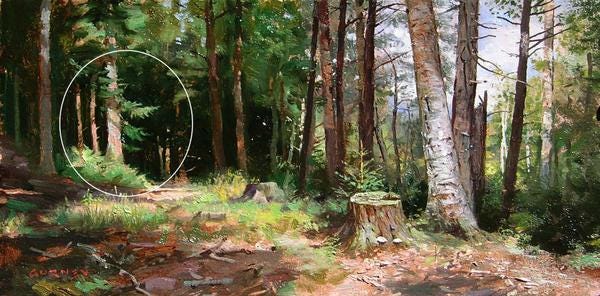
Notice the clearly defined lights on the tree and the deep, dark shadow shapes contrasting on either side of it.
2. Clearly Rendered Shadows
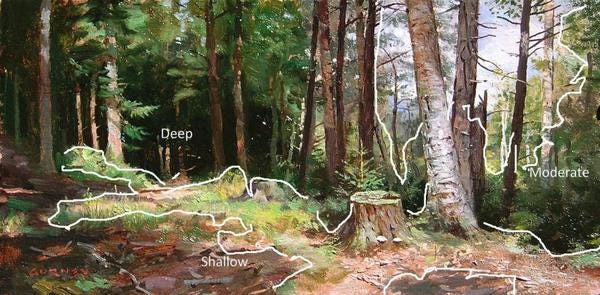
Look at the value, hue, and saturation modulation in Gurney’s moderate and shallow shadows, and how easy our eyes transition from the shallow shadows in the upper tree foliage in light to the deep shadows near the ground.
3. Readable Angles of Light
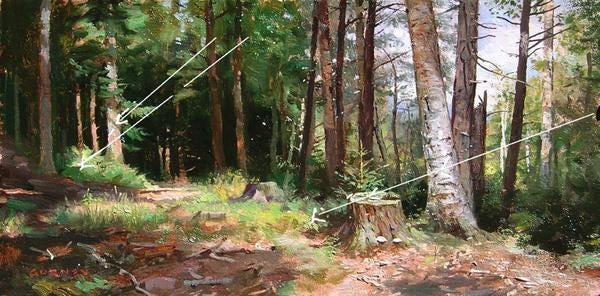
We have no trouble discerning the angle of the sunlight nor reading the scene as being lit from a single light source.
These composition considerations go a long way towards yielding clean values and colors, but they must go hand in hand with a few technical practices. Here are four I suggest:
1. Constantly clean your brush
Make a habit of holding a brush in one hand and a paper towel in the other. Any time you switch colors, rinse and wipe the brush by squeezing it out with the paper towel. Keep your palette knife clean, too!
2. Don’t skimp on paint—cover the surface
Too little paint often results in weak color. Use adequate amounts of paint and avoid stretching it by spreading it so thin that the surface texture comes through. Economy of materials should never be a consideration when creating a painting.
3. Avoid over-stroking and over-blending
Start thinking of your brush as a tool to shape the paint, not as a paint applicator. This means slow down. Be deliberate with each stroke and avoid repeating a stroke in the same spot. Every time you repeat a stroke, you mix the paint. Too much mixing can cause mud.
4. Find the right hue to lighten your colors
Do you reach for white each time you want to make a color lighter? Don’t do that. There might be a light value color that will lighten without losing hue. That doesn’t mean to avoid mixing white. It means when choosing white to watch what it is doing. It might also need a bit of yellow or yellow-orange added to it.
In addition to lightening the value, adding white alone tends to desaturate and cool the hue. (Watercolor painters will know to use the water to make a value lighter.)