

How much content in a composition is needed to express an idea? Is it necessary to say everything completely?
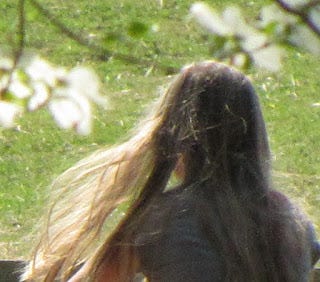
We know this is a person, but where is she? Outdoors or looking out an open window? What is she doing? Is she gazing out over a landscape? Is the wind blowing her hair? An open composition might crop out any degree of information (content), allowing us, the viewers, to complete the story or merely ask questions. Either way, we are engaged.
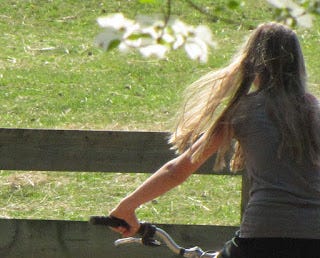
With a bit more information, we can see she's on a bicycle, but is she riding or resting? Is she wearing shorts or slacks or a skirt? Is she making a turn or about to crash into a fence or merely pausing? With this additional information, we are still engaged.
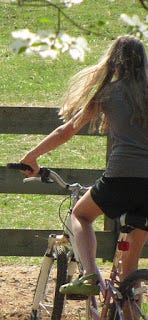
Here we have a bit more information--we discover she's wearing shorts, but we still don't see the entire image. We still don't know whether she is riding or resting or about to crash. Her hair tells us motion is coming from somewhere, but is it from how she's moving or is it wind? The composition is still open.
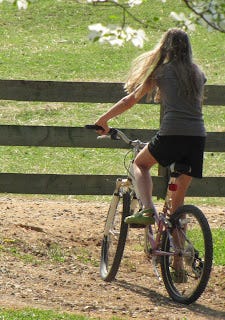
Now the story is more complete. The girl is riding a bike. We might still ask whether she is pausing or about to make a turn. And we’re still not sure whether the wind is blowing or she's making a speedy turn. We have more information about the girl, even though we’re not sure what she is doing beyond riding a bike.
But that is enough, now, to call this a closed composition. When images are cropped so that we see only a portion of the image itself, the label open composition is used to describe the image’s content. Otherwise, with the full image within the picture plane, the content is referred to as a closed composition. How we use either of these depends upon how much of the story we want to tell.
And that is your visual language trivia for the week. Happy Saturday!
Good questions to ask! Can be used in so many applications; my son's photography for example. Are these questions needed in a still life painting? or are there different questions to ask?
Very helpful and interesting way to think when developing a composition, especially with thumbnails.