

ANNOUNCEMENTS:
Join me tomorrow, September 28, at 2 p.m. Eastern for our monthly Live Chat on YouTube. We will explore how the type of boundary we assign to our shapes determines how we perceive them.
NOW, THINKING ABOUT HARMONY
Art reflects life, one way or another. This discord we are feeling in the United States reminds me of how our painting, too, can become dissonant when it loses harmony. It’s no different from a musical instrument being out of tune, something that can sour our senses in a flash.
Harmony means everything is in tune with its source of light. Just as sound frequency tunes a musical instrument, wavelengths of light will tune a painting. The delivery of wavelengths from a light source causes whatever is lit by that source to be in harmonious light. To keep a painting harmonious, we use that principle.
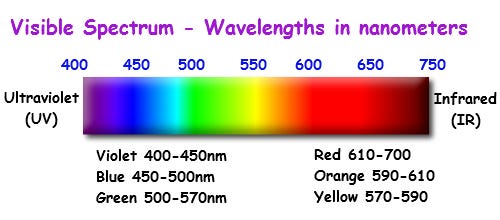
Here’s a chart showing the wavelengths of light in the visible spectrum.
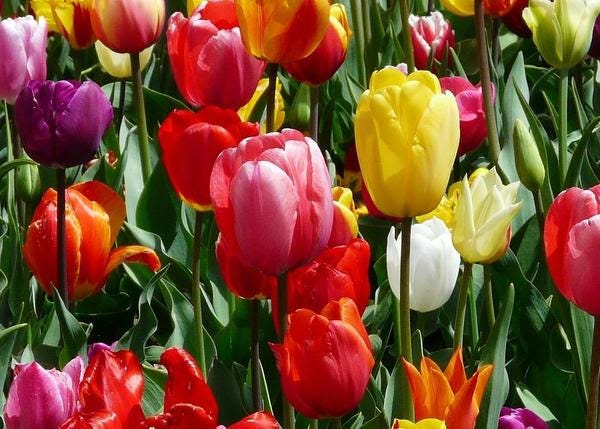
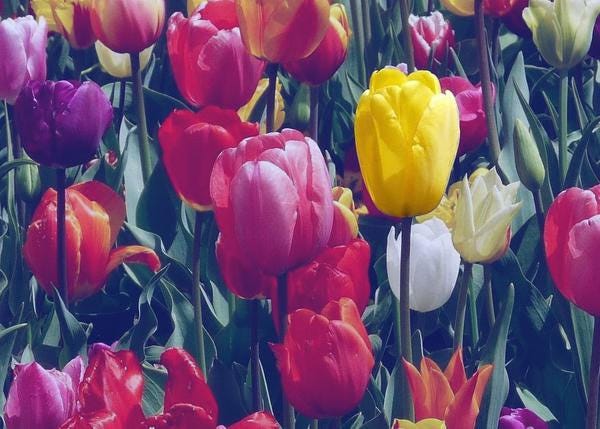
This photo is of tulips in bright sunlight. Even though we see many colors, they feel in harmony because they are all under the same color of light. Another, more scientific way to say it is that the same color wavelengths are hitting everything we see.
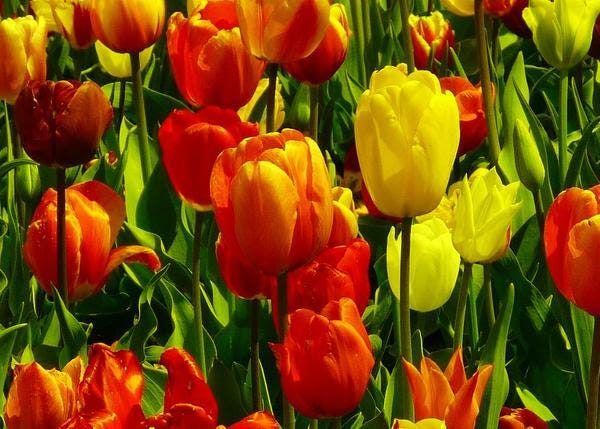
Next, we change the wavelengths to a more orange light, making them a bit longer. Still, everything is in harmony.
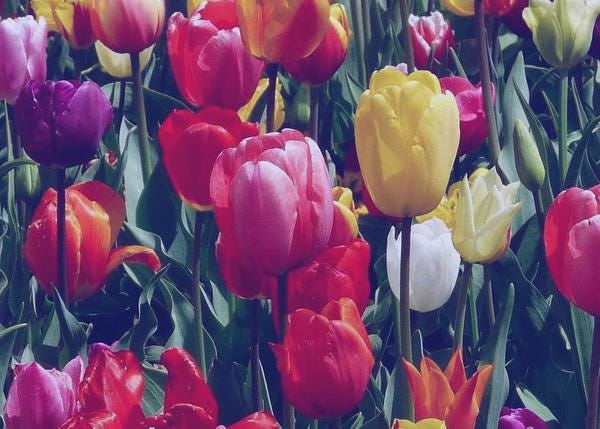
We change the wavelengths again to a blue-violet range, considerably shortening them. The scene is still in harmony.
But when we isolate the frontal yellow tulip and put it under a warmer light of longer lengths, leaving everything else in a cooler, shorter wavelengths of light, we throw it out of harmony.
To put it back into harmony, we simply add to its color the blue-violet light being received by its surroundings. We do that in painting, too.
There’s another fun thing to think about.