

A Good Composition 3: Selecting and Placing
SATURDAY MORNING ART THOUGHTS
I was fortunate during my undergraduate student years to major in painting and minor in music. Fortunate, because music has helped me understand composition in painting far more than any of my painting teachers did. Does that sound odd to you?
For one thing, until the day I had a significant aha moment about composition, I taught, like most painting teachers, that you get your composition first. The aha moment came when, while listening to a Haydn violin concerto, I realized that it could not be true. We can set the placement of our images, but composition develops throughout the painting process, so it cannot possibly be set at the beginning. In fact, only when the painting is finished is the composition there, the same as in music (as well as in all the arts).
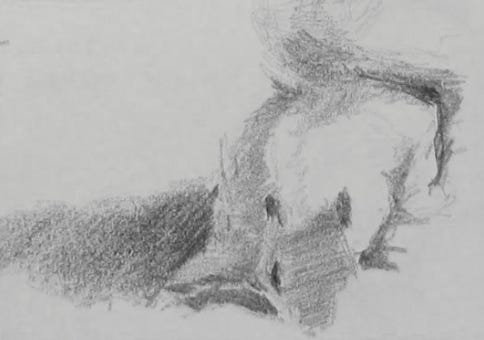
The discoveries artists have made over the centuries have given us several systems for placing our images—the rabatment (used in the drawing above), the golden rectangle, the rule of thirds, dynamic symmetry, and a whole host of others. Some of these are flexible while others are mathematical. While each of these works, not one of them is the only correct way to place images. In fact, for centuries, artists have found ways to defy each one of them and still end up with a workable and fascinating placement of their images. Andrew Wyeth’s The Kuerners is an excellent example.
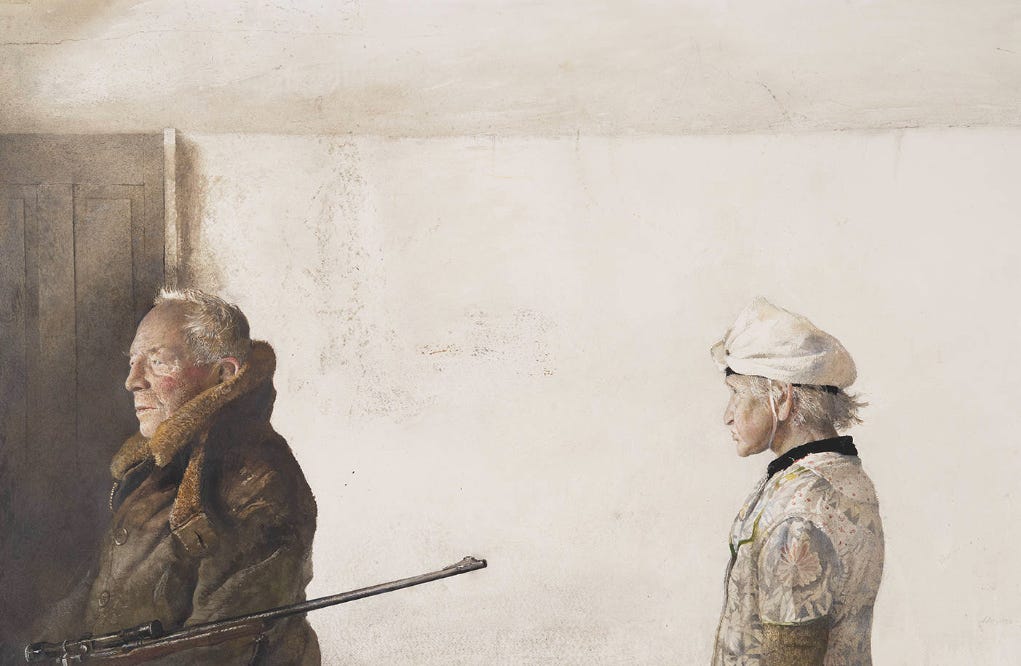
So, if we don’t have rules to follow, how can we be sure we have begun with a placement that will result in a good composition? Ah, yes! The key to that is visual balance. Visual balance works visually the same way physical balance works. Our eyes respond to images and shapes that feel heavier or lighter, depending upon their size, location on the painting surface, and their emphasis.
Look at the placement of Karl and Anna in the Wyeth painting above. Do you notice that the image of Karl and the door behind him is the darkest shape in the painting, and that it is attached to the left side of it, yet it feels balanced with Anna, a single isolated image in that large light space? Is it possible that the gun barrel pointed towards her gives her more visual weight? And that her being isolated in that big empty space adds additional weight to her image? I’d bet my life on it. Yet the “rules” of composition tell us never to place a person’s image (Karl) close to an edge they are looking towards.
_______________________________________________
Now you got me curious about the composition in music. I am going to listen to a Haydn violin concerto 😊
Helpful analysis of Wyeth’s Kuerners. Thank you!! Would love more compositional discussions of famous works of art! You are a wonderful teacher. You find many ways to reinforce your teaching! I am appreciative.